
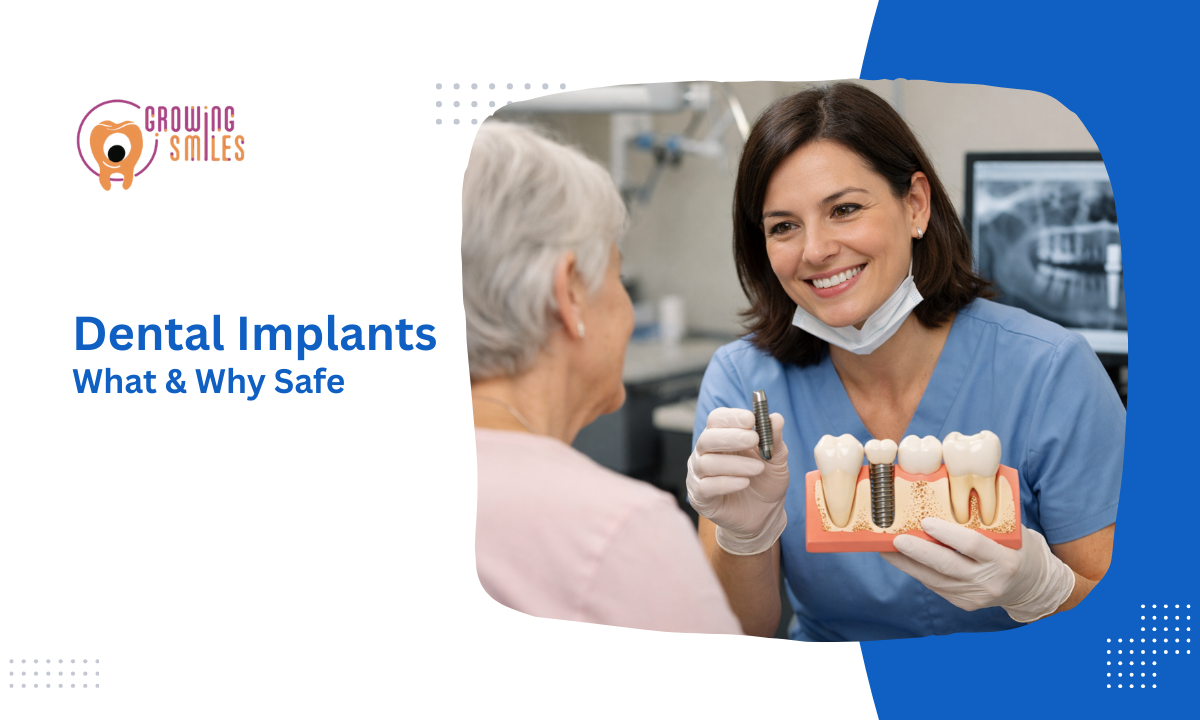
As a practicing dental doctor at Growing Smiles, I meet patients every week who walk into my clinic with the same mix of hope and hesitation. They want their smile back, but they are worried. They ask me, “Doctor, what is a dental implant procedure really like?” and “Are dental implants safe?”
This blog is my personal, professional answer—written not from textbooks alone, but from years of hands-on experience treating real patients, real pain, and real fears.
What are Dental Implants?
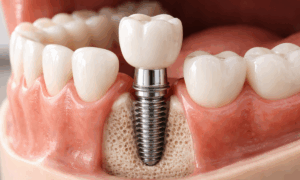
‘What are Dental Implants?’ is one of the most searched questions in modern dentistry—and rightly so. A dental implant is a permanent replacement for a missing tooth root. It is a small, biocompatible titanium post that is surgically placed into the jawbone. Once healed, it acts as a strong foundation for a crown, bridge, or even a full set of teeth.
Unlike removable dentures, implants become part of your body. The titanium integrates naturally with your jawbone through a process called osseointegration. This is the key reason implants feel, function, and look like natural teeth.
From my experience at Growing Smiles, patients often tell me after treatment, “It doesn’t feel like an artificial tooth—it feels like mine.” That statement alone explains the power of dental implants.
Why Dental Implants Are Considered the Gold Standard
When compared to bridges or dentures, dental implants stand out as the gold standard for tooth replacement because they:
- Preserve jawbone strength
- Prevent facial sagging and premature ageing
- Do not damage neighboring healthy teeth
- Offer unmatched chewing efficiency
Many patients initially ask, Is a Dental Implant Safe? The short answer is yes—but let me explain why in detail.
Dental Implants Are Safe: A Doctor’s Perspective

Dental implants are safe because the materials used are medically proven and the procedures are well-established. Titanium has been used safely in medical surgeries for decades, including joint replacements and bone fixation.
At Growing Smiles, patient safety is my highest priority. Before recommending implant surgery, we conduct:
- Detailed digital X-rays and CBCT scans
- Gum and bone health evaluations
- Medical history screening
This careful planning minimizes risks and ensures predictable outcomes. In healthy individuals, the success rate of implants is over 95%, which makes them one of the safest dental procedures available today.
So if you’re wondering, Is A Tooth Implant Safe? The answer is yes, when performed by an experienced dental professional under proper clinical protocols.
How Are Dental Implants Done? Step-by-Step
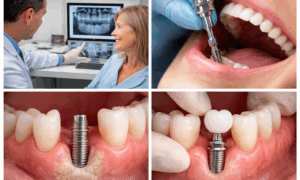
Patients often fear the unknown. Understanding How Dental Implants Are Done helps reduce anxiety significantly.
Step 1: Consultation and Planning
We assess bone density, bite alignment, and oral health. This stage determines whether bone grafting is required.
Step 2: Surgical Implant Teeth Placement
During the dental implant surgery phase, the titanium post is gently placed into the jawbone under local anaesthesia. The procedure is painless, and most patients are surprised by how comfortable it is.
Step 3: Healing and Integration
Over the next 3–6 months, the implant integrates with the bone. This healing phase is critical for long-term success.
Step 4: Crown Placement
Once healed, a custom-designed crown is attached. This crown matches your natural teeth in colour, shape, and strength.
That’s how teeth implantation is done in a safe, controlled, and predictable manner.
Is Dental Implant Surgery Painful?
This is one of the most common fears. From my clinical experience, surgical implant teeth placement is far less painful than most patients expect. With modern anaesthesia and gentle techniques, discomfort is minimal and manageable with routine medication.
Many patients tell me they experienced more discomfort from tooth extractions than from implant surgery.
Can Everyone Get Dental Implants?
Most adults are good candidates, but certain conditions must be managed carefully:
- Uncontrolled diabetes
- Heavy smoking
- Severe bone loss
That’s why personalized assessment matters. At Growing Smiles, I never rush into treatment. Safety always comes first.
How Long Does a Dental Implant Last?
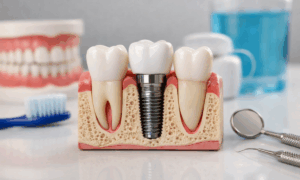
A well-maintained implant can last 20 years or even a lifetime. The implant itself rarely fails; most issues arise from poor oral hygiene or untreated gum disease.
Regular dental check-ups, brushing, flossing, and professional cleaning are essential for longevity. When patients ask, How Long Does A Dental Implant Last?, I tell them—treat it like a natural tooth, and it will reward you the same way.
Dental Implants vs Other Tooth Replacement Options
Unlike dentures that may slip or bridges that rely on adjacent teeth, implants stand independently. They restore confidence, speech, and eating comfort without compromise.
That’s why, as a doctor, I recommend implants when conditions allow—they offer the closest experience to natural teeth.
Final Thoughts
As a dentist at Growing Smiles, I’ve witnessed life-changing transformations through implant dentistry. Patients regain not just teeth, but confidence, comfort, and quality of life.
If you are considering Dental Implants in Whitefield, Bangalore, choosing the right clinic and doctor is just as important as choosing the treatment itself. Safety, experience, and personalized care make all the difference—and that is exactly what we stand for at Growing Smiles.
FAQs – Growing Smiles
1. Is a dental implant safe for elderly patients?
Yes. Age is not a limiting factor. Overall health and bone condition matter more than age.
2. How long does dental implant surgery take?
The implant placement usually takes 30–60 minutes per implant.
3. Are dental implants safe if I have diabetes?
Yes, if diabetes is well-controlled and monitored closely.
4. What is the recovery time after dental implant surgery?
Most patients return to normal activities within 1–2 days.
5. Can dental implants fail?
Failure is rare and usually linked to smoking, poor oral hygiene, or medical conditions.
6. Why should I choose Growing Smiles for dental implants?
Because we combine advanced technology, ethical treatment planning, and a patient-first approach—every single time.